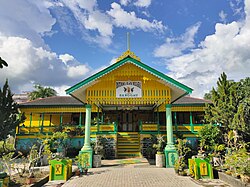
Nestled deep within the lush rainforests of West Kalimantan, the Sanggau Sultanate stands as one of Borneo’s most fascinating and historically rich kingdoms. For centuries, this sultanate carved its identity along the banks of the Kapuas River, weaving together threads of indigenous Dayak culture, Islamic influence, and Malay royal traditions into a tapestry that still resonates with the people of the region today. Understanding the ancient history of the Sanggau Sultanate means embarking on a journey through time — one that reveals how a remote corner of Borneo became a seat of royal power, spiritual authority, and cultural exchange that shaped the broader narrative of the Indonesian archipelago.
The Origins of Sanggau Sultanate in Borneo
The Sanggau Sultanate traces its roots back to a time when the interior of Borneo was a world unto itself — a dense, mysterious landscape inhabited by various Dayak tribal communities who had developed sophisticated social structures, spiritual beliefs, and governance systems long before outside influences arrived. The earliest foundations of what would eventually become the Sanggau Sultanate were laid through the gradual consolidation of power among local chieftains and community leaders who commanded respect through both lineage and spiritual authority. These early leaders were not merely political figures; they were seen as intermediaries between the natural world and the human realm, a role deeply embedded in the animistic traditions of the Dayak people.
The transformation of this tribal society into a formal sultanate was a process that unfolded over many generations, shaped significantly by the arrival of Islam in the Borneo interior. Traders and Muslim missionaries who traveled along the Kapuas River — one of the longest rivers in all of Indonesia — brought with them not just goods and commerce but also a new religious and political framework. The blending of Islamic governance principles with existing Malay and Dayak customs created a unique political identity for Sanggau, one that distinguished it from other sultanates in the region. This syncretism was not forced but rather evolved organically as local leaders saw the benefits of aligning themselves with the growing Islamic political network spreading across maritime Southeast Asia.
Geographically, Sanggau’s position along the Kapuas River was no accident of history — it was a strategic advantage that the early founders of the sultanate clearly recognized and exploited. The river served as the primary highway of trade, communication, and cultural exchange in West Kalimantan, connecting the interior highlands to the coastal ports where goods flowed in and out of Borneo. Control over key sections of this waterway meant control over commerce, taxation, and the movement of people, giving the rulers of Sanggau both economic leverage and political influence that extended well beyond their immediate territory. It was this combination of geographic advantage, cultural adaptability, and strong leadership that allowed Sanggau to emerge as a notable power in the complex political landscape of ancient Borneo.
Early Rulers Who Shaped Sanggau’s Royal Legacy
The early rulers of the Sanggau Sultanate were remarkable figures who understood that building a lasting kingdom required more than military strength — it demanded vision, diplomacy, and the ability to unite diverse communities under a common identity. Among the foundational leaders credited with establishing the royal lineage of Sanggau was a figure whose conversion to Islam marked a turning point in the sultanate’s history. This act of religious conversion was both a personal spiritual journey and a calculated political decision, as it aligned Sanggau with the broader network of Islamic sultanates that were increasingly dominating trade and politics across Southeast Asia during the medieval period. The conversion legitimized the ruler’s authority in the eyes of Muslim traders and neighboring kingdoms while also introducing new systems of law, administration, and governance rooted in Islamic jurisprudence.
What made Sanggau’s early rulers particularly effective was their ability to maintain strong relationships with the indigenous Dayak communities even as they embraced Islamic traditions. Rather than alienating the non-Muslim majority of their subjects, the sultans of Sanggau developed a governing style that respected local customs and integrated Dayak leaders into the administrative structure of the kingdom. This inclusive approach to governance was a hallmark of the sultanate’s political philosophy and explains much of its longevity and stability over the centuries. The early rulers understood that their power ultimately rested on the loyalty and cooperation of the diverse peoples under their rule, and they governed accordingly — with a blend of firmness, generosity, and cultural sensitivity that earned them enduring respect.
The legacy of Sanggau’s founding rulers is still visible today in the cultural traditions, oral histories, and ceremonial practices that have been preserved by the people of the region. Stories of these early sultans are passed down through generations, often blending historical fact with mythological elements in the tradition of Southeast Asian royal chronicles known as hikayat. These narratives speak of rulers who possessed not just political authority but also supernatural powers and divine favor — qualities that reinforced the sacred nature of royal rule in the minds of their subjects. The palaces, royal regalia, and ceremonial objects associated with these early leaders serve as tangible connections to a royal past that the people of Sanggau continue to honor and celebrate, keeping the memory of their ancient sultanate very much alive in the present day.
The ancient history of the Sanggau Sultanate is a story that deserves far more attention than it typically receives in mainstream historical discourse. From its humble origins among the riverine communities of West Kalimantan to its emergence as a sophisticated Islamic sultanate with a rich royal tradition, Sanggau represents the remarkable capacity of human communities to adapt, evolve, and thrive in even the most challenging environments. The sultanate’s legacy is not merely a matter of historical record — it is a living heritage that continues to shape the cultural identity of the people of Sanggau and the broader region of West Kalimantan. As we look back at the ancient history of this remarkable kingdom, we are reminded of the complexity and richness of Borneo’s past, and the importance of preserving these stories for future generations who deserve to know the full depth of their ancestors’ extraordinary achievements.